

Manufacturing is changing rapidly.
Consumer expectations, retailer requirements, sustainability initiatives, and digital traceability are driving significant changes across production and packaging operations.
To remain competitive, manufacturers must ensure their production lines can support:
The manufacturers best positioned for success in 2027 and beyond will be those investing in scalable systems that can adapt as industry requirements evolve.

Several key trends are shaping the future of packaging and production lines.
Production environments are becoming increasingly dynamic.
Manufacturers are managing:
Traditional production systems designed for long, consistent runs often struggle to keep pace.
Flexible automation allows manufacturers to adapt quickly while maintaining efficiency and reliability.
Modern production lines can no longer operate as isolated systems.
Labelling, coding, inspection, and packaging equipment increasingly need to communicate with:
Integrated systems improve visibility, reduce manual processes, and help manufacturers make better operational decisions.
Sustainability remains a major focus across the manufacturing sector.
Many businesses are introducing:
However, these changes can impact coding, marking, and labelling performance.
Manufacturers should ensure production equipment can support sustainable packaging materials without sacrificing throughput or product quality.
One of the biggest drivers of change is the increasing demand for product traceability.
Consumers, retailers, regulators, and supply chain partners want access to more detailed product information than ever before.
This is where GS1 Sunrise 2027 becomes highly relevant.
edited.png)
.png)
GS1 Sunrise 2027 is a global initiative designed to accelerate the adoption of 2D barcodes alongside traditional linear barcodes.
By the end of 2027, retailers and supply chain partners are expected to be capable of scanning and processing 2D barcodes such as QR Codes and GS1 DataMatrix symbols at point of sale.
These next-generation barcodes can contain significantly more information than traditional linear barcodes, including:
The initiative aims to improve supply chain visibility, food safety, product authentication, recall management, and consumer engagement.
Many manufacturers are asking:
Not necessarily.
However, manufacturers should review whether their current coding, marking, inspection, and labelling systems can:
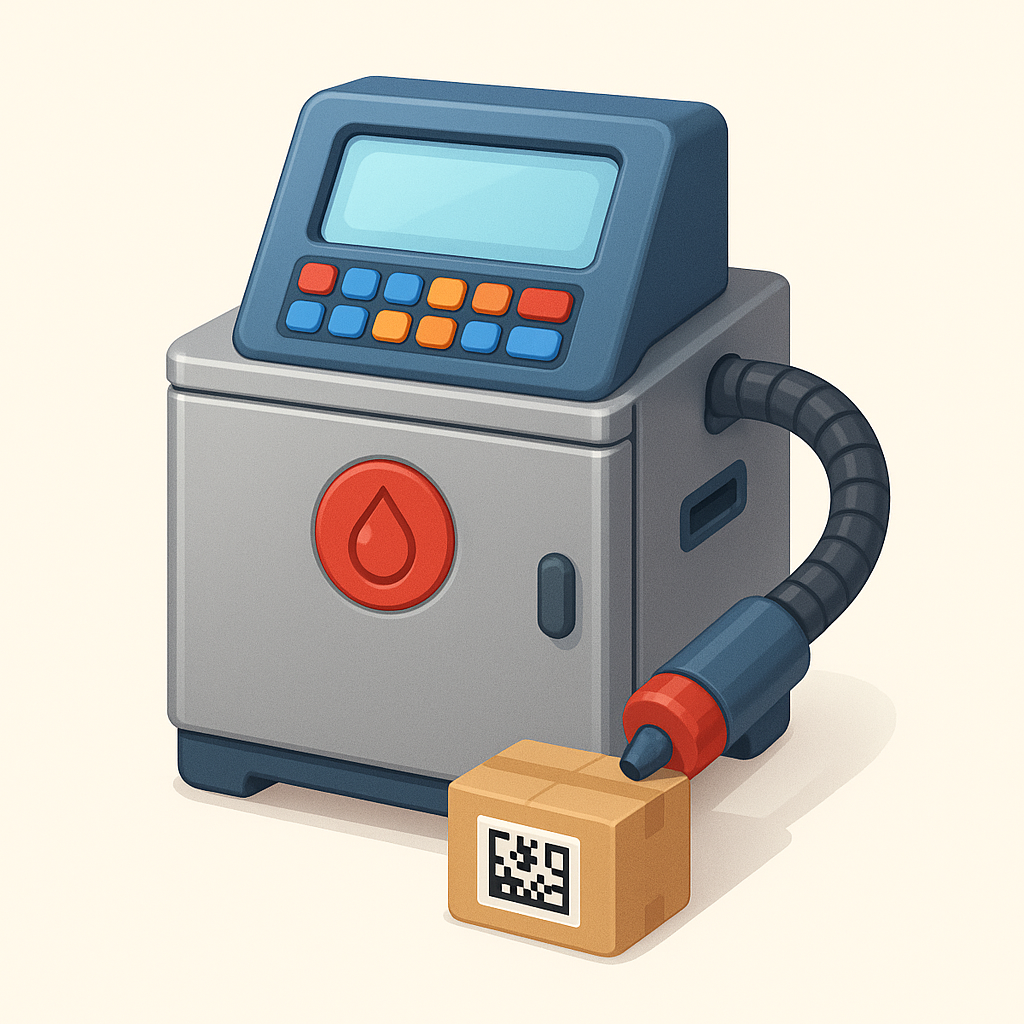
For some businesses, upgrades may be required to ensure compliance with future retailer and supply chain expectations.
2D barcodes support significantly more data than traditional linear barcodes.
Benefits include:
Improved Traceability
Track products throughout the supply chain.
Faster Product Recalls
Identify affected batches quickly and accurately.
Better Consumer Engagement
Enable consumers to access product information instantly through a smartphone scan.
Enhanced Supply Chain Visibility
Improve inventory management and product authentication.

As GS1 Sunrise 2027 approaches, manufacturers should assess:

Can our current coding system print 2D barcodes?
Supports future retailer requirements
Can our scanners and vision systems verify 2D codes?
Ensures readability and compliance
Are our labelling systems flexible enough for future changes?
Supports long-term adaptability
Can our production data integrate with traceability systems?
Enables end-to-end visibility
Are we prepared for changing customer expectations?
Protects future competitiveness
While automation, sustainability, and traceability continue to evolve, one factor remains constant:
Reliability.
A highly automated production line still needs to deliver:
Future-ready manufacturers balance innovation with operational stability.
The transition to more connected, traceable, and sustainable manufacturing is already underway.
Manufacturers that proactively review their coding, marking, labelling, and automation capabilities today will be better positioned to meet future customer, retailer, and regulatory requirements.
Whether you're planning for GS1 Sunrise 2027, expanding production capacity, or improving packaging efficiency, investing in scalable and adaptable systems can help protect your operation for years to come.
There are a number of coding and labelling suppliers operating in Australia and New Zealand. What separates ALDUS™ Tronics is not just the breadth of technology we offer, but what stands behind it.
ALDUS™ Tronics has been a Videojet authorised distributor in Australia for over 20 years, and is the exclusive distributor for Videojet in New Zealand. Our technical team is trained directly by Videojet, which means the knowledge we bring to your line reflects the same engineering depth that sits behind the equipment itself. When we assess a substrate compatibility challenge, we are not reading from a generic troubleshooting guide. We are drawing on more than two decades of application experience across food, beverage, pharmaceutical, pet food, personal care, and industrial manufacturing environments in this region.
That local presence matters more than it might initially appear. When something changes on your line, whether that is a new substrate arriving from a supplier, a speed increase, or an unexpected spike in rejects, you need a team that can be with you quickly. Not a global support queue. Not a remote diagnosis from a different time zone. ALDUS™ Tronics provides local technical support, local parts inventory, and local people who understand the specific regulatory and operational context of manufacturing in Australia and New Zealand.
Our technology range spans continuous inkjet, thermal inkjet, UV and CO2 laser coding, thermal transfer overprinting, and print and apply labelling. That breadth means we can recommend the right solution for your specific combination of material, environment, and performance requirement rather than fitting your needs around a limited catalogue.
We are not a transactional supplier. We are a long-term production partner. The food manufacturer described above did not just get a piece of equipment from us. They got an assessment, a recommendation, an installation, and ongoing support from a team that now understands their line and their materials. That relationship does not end at commissioning.
.svg)

